Six-month operating partnership · established ecommerce stores

Extract €250K–€1M/mo from Google.

My own stores do €4M a month on Google. For six months I do the same work on yours: deciding what to sell next, building it into catalog and feed, and holding every dollar of spend to your real economics. GDOS, the decision system I built for my own operation, supplies the throughput. You approve anything material.

for established stores doing €100k+/month · Merchant Center in good standing · roughly €20k+/month in Google spend

~2-minute application · five active partnerships maximum · straight answers, including “not yet.”

Portfolio revenue

€4M / month

combined, current · aggregate across my own stores

Stores operated

~20

Google + Meta, own operations

Exits

Multiple

completed store sales

Capacity

5 max

active operating partnerships

€4M/month is combined topline across my own portfolio, not one store and not a client result. Verification available to qualified applicants.

00 / The offer, plainly

You're hiring an operator. Not buying software.

For six months, I work on your store. I research what you should sell next, build approved winners into your catalog and feed, run controlled Google tests under kill rules, and make the weekly kill/scale calls with you. Done for you, decided with you, with the reasoning on the table every week. It starts with a €5,000 audit that ends in a written go/no-go; the full engagement is €50,000 total, audit credited. GDOS, the software I built, is how the work gets done at speed. The offer is the work, and the thinking behind it. By month six, the capability lives in your company, not mine.

done-for-you execution · your approval on anything material · full visibility into how every decision is made

01 / The constraint

Two decisions cap your growth: what to sell next, and where the next dollar goes.

Established stores rarely stall on effort. They stall on decision quality, in the catalog and in the spend:

More spend doesn't fix this, and neither does another dashboard. A decision system between your money and Google does: one that governs both what you sell and how you spend.

02 / Product research

“What do we sell next?” Answered with evidence.

The biggest lever GDOS gives an established store is disciplined catalog expansion. Each research cycle evaluates candidate products against real demand, competitive Shopping prices, supplier economics, gross margin and break-even thresholds. Most candidates die there. Survivors reach you as scored proposals with the evidence attached.

orange = human decision points. nothing is added to your store, and nothing material is scaled, without sign-off.

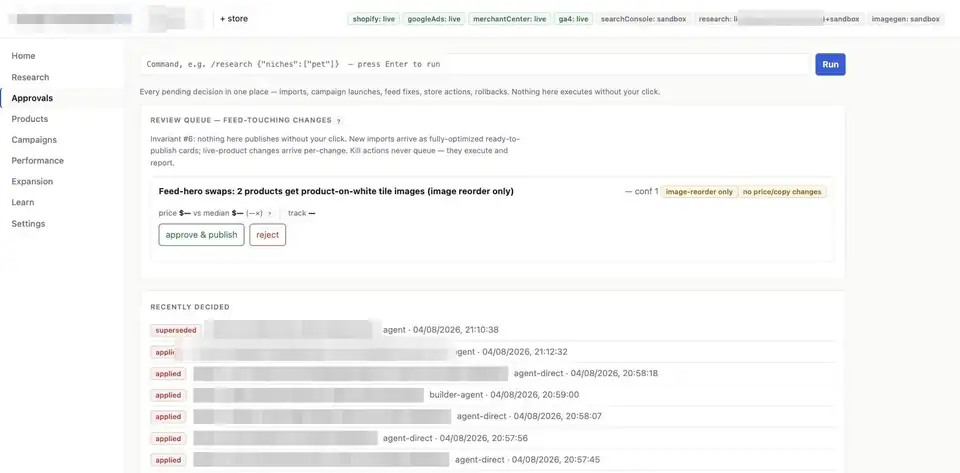
GDOS research and approval queue: researched product candidates and proposed catalog additions with statuses, decision types and audit trail; product names redacted
The research queue, live. Researched product candidates and proposed catalog additions moving through approval, with the audit trail. Product names are redacted to protect live research.

03 / The operator

One operator. No agency layer.

FxScaler is run by a single operator: no account managers, no handoffs. I've operated ~20 ecommerce stores across Google and Meta, completed multiple exits, and currently run a portfolio doing a combined €4M/month topline. Not one store, and not a client result.

GDOS exists because my own portfolio needed it. The partnership installs the same system on your store, with me in the weekly seat. The software carries the research throughput and the monitoring; the judgment — what to approve, what to kill, what to scale — is work we do together.

contact: @FxScaler on X

04 / The method

One loop from research to P&L.

The method runs on GDOS, the Google Decision Operating System: proprietary software I built to run my own portfolio. It isn't sold and there's no subscription. I install it on your store and operate it with you, in five layers. Glass-box, not black-box: every recommendation arrives with its evidence and reasoning attached.

01

Measurement & economic truth

Orders, COGS, shipping, payment fees, refunds and acquisition costs reconciled into contribution, per SKU. Every decision downstream runs on this number, not platform ROAS.

02

Product research & opportunity scoring

Continuous research cycles score candidate products and expansion opportunities against demand, competitive Shopping prices, supplier economics and break-even thresholds. Survivors become evidence-backed proposals.

03

Catalog & feed execution

Approved products become live, structured catalog: titles, categories, attributes and price positioning built so Google can find and serve the winners instead of hiding them.

04

Controlled testing & kill/scale guardrails

Every launch carries its own break-even math and kill rules from day one. Losers stop spending in days, not after a quarter of “let it optimize.” Budget follows contribution, inside limits we agree upfront.

05

Operator cadence & approvals

Daily GDOS monitoring, plus one weekly P&L session with me: what contribution says, what we kill, what we scale, what we test next. Material changes require your approval, and the audit trail records every decision.

05 / Verification

See the system before you commit.

These are live interface views from GDOS operating across my own portfolio. Store, product and market identities are redacted. Qualified applicants receive a private system walkthrough and, where permissible, store-level verification before any engagement begins.

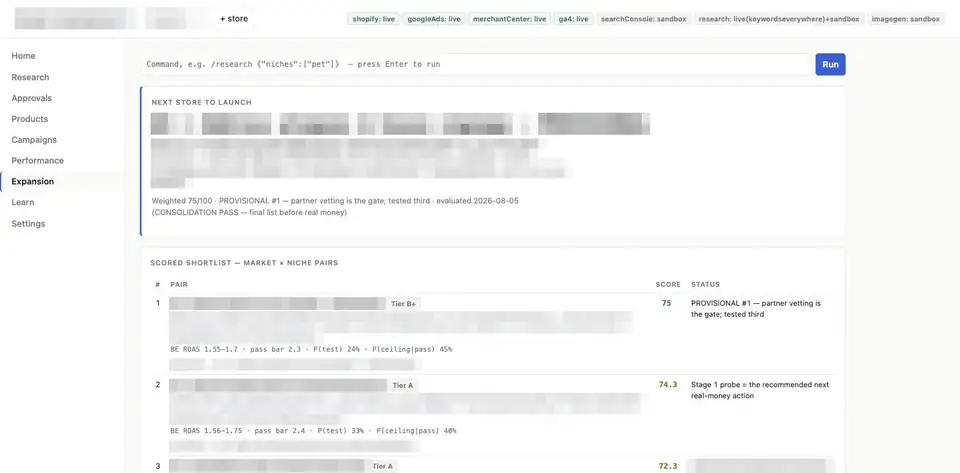
GDOS expansion planner: weighted opportunity scores, break-even ROAS versus pass bars and downside ranges visible; market and niche names redacted
Expansion planner. Weighted opportunity scores, break-even ROAS against pass bars, downside ranges. Market and niche names are redacted to protect live research.

06 / Timeline

Fourteen days to truth. Six months to a capability.

DAYS 1–14

Audit: economics, constraints, opportunity map

Measurement and data-integrity audit, contribution-margin model, feed and Ads assessment, research and opportunity map, prioritized implementation backlog, and a written go/no-go recommendation.

WEEKS 3–6

Install and configure

The core GDOS workflow set up against the audit's findings: measurement, feed and campaign structure, and the first research and decision backlog.

MONTHS 2–3

Research, approve, test

Ongoing research cycles, approved catalog additions executed into the feed, and controlled tests run under defined economic rules.

MONTHS 4–6

Scale, refine, hand over

Credible winners expanded, rules and feeds refined, the operating cadence tightened, and the system documented for a durable handoff or continuation.

07 / Commercial scope

One six-month relationship. Stage-gated start.

Stage 1 · Profit Systems Audit14 days

€5,000

fully credited toward the €50,000 total if the engagement continues

  • Measurement and data-integrity audit
  • Contribution-margin model, per SKU
  • Merchant Center, feed and Google Ads assessment
  • Research and opportunity map: what's worth adding next
  • Prioritized 90-day implementation backlog
  • Written go/no-go recommendation
If the evidence doesn't support a credible partnership case, my recommendation is that you stop here, and you keep everything the audit produced.
Stage 2 · Operating Partnership6 months total

€50,000

total, audit credited; the remaining €45,000 covers implementation and ongoing operation

  • GDOS installation and configuration
  • Contribution-profit measurement
  • Continuous product research and opportunity scoring
  • Catalog and feed execution on approved products
  • Controlled testing with kill/scale guardrails
  • Glass-box decisions: evidence and rationale attached
  • Daily system monitoring
  • Weekly operator-level P&L session
  • Documentation and durable handover
Excludes ad spend, inventory, supplier costs and third-party platform costs. Five active operating partnerships maximum.

The risk reversal is the audit itself: every engagement begins with the paid audit and an explicit go/no-go decision. The commitment is to install and operate the decision system, not to promise outcomes controlled by markets or advertising platforms.

08 / Fit

This partnership is built for a specific operator.

Built for you if

  • You operate a validated store doing roughly €100k+/month
  • Google Ads and Merchant Center are active and in good standing
  • Roughly €20k+/month is available for Google advertising
  • You can provide true COGS, shipping, refund and fee data, and fulfillment is reliable
  • You (or a senior operator) will make decisions in a weekly session and can add and test products

Not for

  • First-time store owners or pre-revenue businesses
  • Anyone hunting one magic product instead of building a catalog process
  • Businesses without the data or budget for the system to have leverage
  • Owners who want outsourced ad-clicks with no operational involvement, or guaranteed outcomes. None are made here

Account-readiness questions for otherwise qualified businesses are evaluated separately, case-by-case. Approval is never guaranteed.

09 / Questions

Asked before you ask.

Q.01

Why is the audit paid?

Because it's real senior work (a contribution model, a data audit, a research map and a 90-day plan you keep either way), and because it protects both of us. It's fully credited toward the partnership, and if the evidence says the opportunity isn't there, I'll tell you to stop. A free audit would make that honesty expensive for me; a paid one makes it the deliverable.

Q.02

Can I just buy GDOS?

No. GDOS isn't sold as software, at any price. It's how I run my own stores. What's for sale is the operating partnership: the system does research throughput, monitoring and guardrails, and I work on the store with you. When the engagement ends, you keep the installed workflow, the decision rules and the documentation.

Q.03

My Merchant Center isn't in good standing. Can you get me approved?

No. Approval and continued approval are Google's decisions and can't be guaranteed by anyone. This partnership is built for accounts already in good standing. For otherwise qualified businesses, account readiness is evaluated separately, case-by-case, with no approval outcome promised.

Q.04

What do you need from me?

Data access: Shopify, Google Ads, Merchant Center, plus true COGS, shipping, refund and fee data; contribution truth requires all of it. A decision-maker in the weekly session. Operational capacity to add and test products. And agreed authority thresholds, so the system knows what it may do routinely and what comes to you.

Q.05

How much runs on its own?

Routine actions run inside guardrails we define together: limits, tripwires, kill rules. Research proposals, catalog additions, material budget changes and structural decisions require human approval: yours where it's your store and money, mine where it's operating judgment. The system never exceeds the authority you've given it.

Q.06

We already have an agency or an in-house buyer.

Different job. Media buying is activity; this is the decision layer: what to sell next, SKU-level contribution economics, and weekly kill/scale calls that a buyer can execute against. It can coexist with your current setup. And if your setup already gives you evidence-scored catalog expansion and per-SKU contribution truth, you don't need me.

Q.07

I'd rather learn how you decide than outsource it.

Good. That's how this is built. Every research proposal carries its scoring and evidence; every kill/scale call happens with you in the weekly session, reasoning on the table; and the engagement ends with documentation your team can run without me. You're not renting outputs, you're installing a capability. If you specifically want an advisory-only arrangement around the methodology, without the execution layer, say so in your application; a small number are considered case-by-case.

10 / Apply

If this reads like your store, apply.

Five active partnerships, because every one gets a weekly senior-operator session and an operated system. Straight answers, including “not yet.”

The application asks for seven things:

01 — your name
02 — business email
03 — store URL
04 — monthly revenue range
05 — monthly Google spend
06 — Merchant Center status
07 — your main commercial bottleneck

~2 minutes · reviewed personally · see privacy & terms before applying

OPERATING PARTNERSHIP · established stores · 5 seats

APPLY